
Titanium Material Impeller Inspection – Ensuring Integrity and Performance for High‑Speed Rotating Equipment
In Azerbaijan’s oil & gas, petrochemical, and power generation industries, titanium material impeller inspection is critical for verifying the structural integrity, fatigue resistance, and corrosion durability of impellers used in centrifugal compressors, pumps, and turbines. Titanium alloys (e.g., Ti‑6Al‑4V, Ti‑3Al‑2.5V) are chosen for their high strength‑to‑weight ratio, excellent corrosion resistance, and fatigue performance. However, manufacturing defects (porosity, inclusions, surface cracks) or in‑service damage (erosion, pitting, stress corrosion cracking) can lead to catastrophic failure. Our ISO/IEC 17025 accredited laboratory performs comprehensive non‑destructive and dimensional inspections – including penetrant testing, radiographic examination, ultrasonic flaw detection, coordinate measuring, and surface roughness analysis – to ensure that titanium impellers meet design specifications and safety standards.
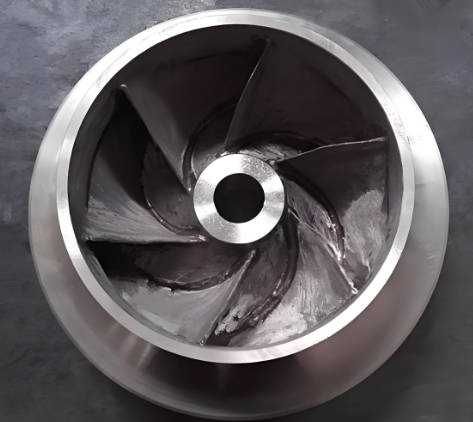
Key Defects and Inspection Parameters for Titanium Impellers
We evaluate multiple critical aspects to guarantee the reliability of titanium impellers in demanding rotating machinery.
1. Liquid Penetrant Testing (PT) – Surface Cracks and Porosity
Using fluorescent or visible dye penetrant, we inspect the entire impeller surface (blades, hub, fillets, and bore) for cracks, laps, and open porosity. The part is cleaned, penetrant applied, dwelled, excess removed, and developer applied. Any indication is measured and compared to acceptance criteria (e.g., no linear indications > 1.5 mm, no rounded indications > 3 mm). This test is essential for detecting machining tears or forging laps.
2. Radiographic Testing (RT) – Internal Defects
For cast or additively manufactured (3D‑printed) titanium impellers, we perform X‑ray or gamma‑ray radiography to detect internal porosity, shrinkage cavities, or inclusions. Images are evaluated against reference standards (e.g., ASTM E155). For critical aerospace‑grade impellers, defect acceptance levels are very strict (e.g., porosity < 1% of section thickness).
3. Ultrasonic Testing (UT) – Subsurface Flaws
Using a phased array or conventional UT probe, we scan the impeller’s critical zones (blade roots, hub, and shaft interface) for lack of fusion, delamination, or cracks. Calibration is performed on a reference block with flat‑bottom holes. Immersion UT may be used for complex geometries.
4. Dimensional Inspection (Coordinate Measuring Machine – CMM)
We measure blade profiles, hub bore diameter, keyway dimensions, and overall impeller geometry against the CAD model or engineering drawing. Using a touch‑probe or laser scanner CMM, we report deviations (e.g., blade tip contour tolerance ±0.05 mm, runout ≤ 0.02 mm). Excessive deviation affects aerodynamic/hydraulic efficiency and balance.
5. Surface Roughness and Visual Examination
Using a profilometer, we measure Ra, Rz, and Rmax on blade surfaces, fillets, and sealing surfaces. Typical requirements: Ra ≤ 0.8 µm for flow surfaces, Ra ≤ 0.4 µm for sealing lands. Visual inspection (10× magnification) detects galling, scratches, or discoloration (indicating overheating).
6. Hardness and Material Verification (PMI)
We perform portable hardness testing (Leeb or Vickers) on critical areas to verify heat treatment condition (e.g., 30–36 HRC for Ti‑6Al‑4V). Positive Material Identification (PMI) using XRF or OES confirms titanium grade and detects unintended alloy mixing (e.g., Fe, Al, V levels).
7. High‑Speed Balancing (Spin Testing)
For impellers operating above 10,000 rpm, we perform dynamic balancing on a high‑speed spin test stand. We measure unbalance (g·mm) at operating speed and verify that residual unbalance is below the tolerance (e.g., G2.5 or G1.0 per ISO 1940). This prevents vibration and bearing overload.
8. Corrosion and Stress Corrosion Testing (Optional)
For impellers used in seawater or sour gas services, we perform accelerated corrosion testing (salt spray per ASTM B117) and stress corrosion cracking tests (U‑bend or C‑ring specimens) to evaluate resistance to chloride‑induced cracking.
9. Resonance and Natural Frequency Measurement (Modal Analysis)
We perform impact hammer modal testing to determine natural frequencies of the impeller. Results are compared to the operating speed range to avoid resonant vibration (critical speed margin typically > 15%).
Reporting and Deliverables
Our titanium material impeller inspection report includes:
- Impeller identification (part number, serial number, titanium grade, manufacturer).
- NDT results (PT, RT, UT images and acceptance).
- CMM dimensional deviation plots (color map).
- Surface roughness and hardness values.
- Balancing certificate (unbalance measurements).
- Pass/fail conclusion based on client‑supplied specifications.
- Raw data (radiographs, ultrasonic scans, CMM files) archived for 10 years.
We do not issue generic compliance statements without specific acceptance criteria. Our reports are accepted by local oil & gas operators, pump manufacturers, and third‑party inspectors.
In summary, thorough titanium material impeller inspection ensures that high‑speed rotating machinery operates safely and efficiently, preventing costly unplanned downtime in Azerbaijan’s energy and industrial sectors.
Applications in the Azerbaijani Market
- Oil & gas (BP, SOCAR platforms): Centrifugal compressor impellers in gas lift and injection systems.
- Petrochemical (Sumgayit, Baku): Corrosive service pumps with titanium impellers.
- Power generation (Mingachevir, Shirvan): Turbine feedwater pumps and condensate extraction pumps.
- Aerospace (maintenance facilities): Titanium fan blades and compressor wheels.
- Desalination plants: Seawater reverse osmosis high‑pressure pumps.
Why Choose ZKGX?
- State-of-the-art analytical equipment
- Highly qualified scientific team
- Fast turnaround time
- Competitive pricing