
Insulation Oil Testing – Comprehensive Analysis for Transformer Reliability and Power System Safety
As an ISO/IEC 17025 accredited (CNAS) independent laboratory, we provide specialized insulation oil testing services to power utilities, transformer manufacturers, renewable energy operators, and industrial facilities in Azerbaijan. Insulation oil (transformer oil) serves as both electrical insulation and coolant in power transformers, switchgear, and circuit breakers. Its quality degrades over time due to moisture ingress, oxidation, formation of acids and sludge, and dissolved gases from electrical faults. Our comprehensive testing – including dielectric breakdown voltage, moisture content, dissolved gas analysis (DGA), acidity, interfacial tension, and particle count – helps predict transformer health, prevent catastrophic failures, and extend equipment service life.
Why Regular Insulation Oil Testing is Critical for Azerbaijani Power Infrastructure
Azerbaijan’s power grid relies on thousands of transformers operating under demanding conditions – high ambient temperatures in summer, heavy loads, and aging equipment. Regular insulation oil testing identifies developing faults such as partial discharges, overheating, or arcing before they cause outages. Our laboratory follows IEC 60422, ASTM D3487, and GOST 982-80 standards, adapted to local operational requirements. By tracking key parameters, we help utilities plan predictive maintenance, reduce unplanned downtime, and ensure compliance with safety regulations.
Key Parameters and Test Methods for Insulation Oil Quality
1. Dielectric Breakdown Voltage (BDV) – ASTM D877 / IEC 60156
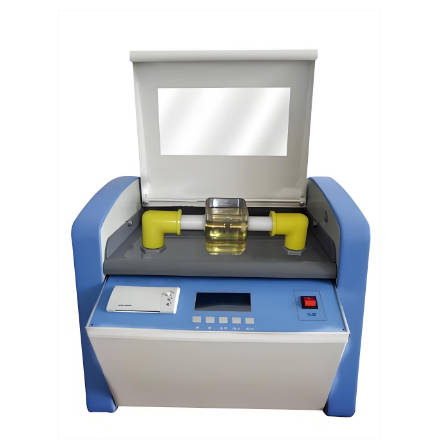
This test measures the voltage at which the oil fails electrically, indicating contamination by moisture, particles, or conductive sludge. A BDV below 30 kV (for new oil) or below 20 kV (for in‑service oil) signals degradation. Our automated BDV tester applies a rising AC voltage across two electrodes immersed in the oil sample, recording the flashover voltage.
2. Moisture Content (Karl Fischer Titration) – IEC 60814
Water in insulation oil drastically reduces dielectric strength and accelerates paper insulation aging. Using coulometric Karl Fischer titration, we measure moisture content with a detection limit of 1 ppm. Typical acceptable limits: < 10 ppm for new oil, < 35 ppm for in‑service transformer oil.
3. Dissolved Gas Analysis (DGA) – IEC 60567 / ASTM D3612
DGA is the most powerful diagnostic tool for oil‑filled transformers. We extract gases (hydrogen, methane, ethane, ethylene, acetylene, carbon monoxide, carbon dioxide) from the oil sample and analyze them by gas chromatography. The relative concentrations indicate specific fault types: corona (high H₂), overheating (high C₂H₄, CH₄), or arcing (high C₂H₂). Our reports include Duval triangle and key gas ratio interpretations.
4. Acidity (Neutralization Number) – ASTM D974 / IEC 62021
Acid formation from oil oxidation causes corrosion of internal metal parts and accelerates paper degradation. We measure total acid number (TAN) in mg KOH/g. Acceptable limits: new oil < 0.03 mg KOH/g; in‑service oil < 0.2 mg KOH/g (action limit).
5. Interfacial Tension (IFT) – ASTM D971
IFT measures the oil‑water interface tension, which decreases as polar oxidation products accumulate. Values below 20 mN/m indicate severe oxidation and sludge formation. New oil typically > 35 mN/m.
6. Breakdown Voltage of Reclaimed Oil (for re‑refining quality control)
For recycled or reclaimed transformer oil, we verify that after treatment the BDV meets or exceeds 50 kV to ensure safe reuse.
Specialized Tests for Transformer Health Assessment
7. Particle Count (ISO 4406) – Microscopic or Automatic Particle Counter
Solid particles (metal fines, carbon, fibers) can initiate electrical discharges. We count particles per milliliter in size ranges > 5 µm, > 15 µm, etc. High particle loads indicate wear or contamination from pump bearings or cellulose degradation.
8. Density, Viscosity, and Flash Point – ASTM D1298, D445, D92
These physical properties verify that the oil meets the original specification (e.g., mineral oil type I or II). Significant changes indicate contamination or mixing with incompatible fluids.
9. Polychlorinated Biphenyls (PCBs) Screening – EPA 8082 / IEC 61619
For old transformers, we test for PCBs (toxic and regulated). Presence above 50 ppm requires special disposal under Basel Convention rules.
Interpretation and Reporting – Actionable Insights
Each insulation oil testing report includes not only measured values but also a clear diagnosis (e.g., “normal aging”, “overheating – check load and cooling”, “partial discharge activity detected”) and recommended actions (e.g., “re‑filter oil”, “take offline for internal inspection”). We also provide trend analysis when historical data is available, enabling predictive maintenance planning.
Quality Assurance and Accreditation
Our laboratory operates under ISO/IEC 17025 with traceable calibration of all test equipment. We participate in international proficiency testing schemes (e.g., ASTM, Intertek) to ensure accuracy. Results are accepted by local regulatory bodies and international insurers.
Reporting and Deliverables
Each oil sample report includes:
- Sample identification (transformer ID, oil type, sampling date).
- Test results for BDV, moisture, DGA, acidity, IFT, particle count, and other requested parameters.
- Reference limits (new oil, in‑service caution, in‑service action).
- Diagnostic conclusion and recommendations.
- Raw data (gas chromatograms, titration curves) archived for 10 years.
No statement of compliance with any external standard is made unless the client provides specific acceptance criteria. The report is intended for asset management, predictive maintenance, and transformer life extension.
Applications in the Azerbaijani Energy Sector
- Hydroelectric and thermal power plants (Mingachevir, Shirvan, Baku): Routine DGA and BDV monitoring of generator step‑up transformers.
- Substations of Azerenergy and regional distribution companies: Seasonal insulation oil testing before peak load periods.
- Renewable energy (wind and solar farms): Condition assessment of collector transformers.
- Industrial facilities (petrochemical, mining, steel): Oil testing for furnace transformers and rectifiers.
- Transformer repair and reconditioning workshops: Verification of reclaimed oil quality.
Why Choose ZKGX?
- State-of-the-art analytical equipment
- Highly qualified scientific team
- Fast turnaround time
- Competitive pricing