
Glass Fiber Rope Inspection – Quality Assurance for High‑Temperature Sealing and Thermal Insulation Applications
In Azerbaijan’s oil and gas refineries, power plants, and industrial furnaces, glass fiber rope inspection is essential to verify that ropes used for high‑temperature sealing, door gaskets, and thermal insulation maintain their mechanical integrity, heat resistance, and dimensional stability. Glass fiber ropes (also known as fiberglass rope, glass cord, or packing rope) are widely used in boilers, ovens, chimneys, and exhaust systems to seal gaps against heat, flame, and corrosive gases. Our ISO/IEC 17025 accredited laboratory provides comprehensive inspection services – including visual and dimensional checks, tensile strength, ignition loss, thermal stability, abrasion resistance, and chemical compatibility – to ensure compliance with international standards (ASTM D579, DIN 60067, ISO 1886) and local industry requirements for safety and efficiency.
Key Parameters and Test Methods for Glass Fiber Rope Inspection
We evaluate multiple critical aspects to guarantee the reliability of glass fiber ropes in high‑temperature and corrosive environments.
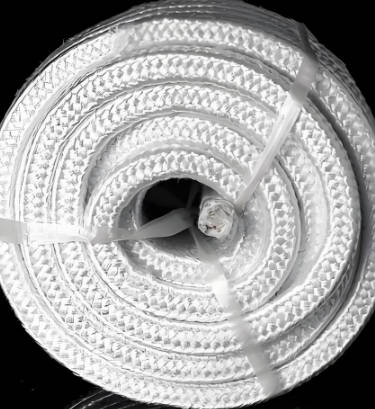
1. Visual and Dimensional Inspection – Thread Count, Diameter, Twist
Under good lighting, we examine the rope surface for broken filaments, knots, kinks, color variation (indicating heat damage), and foreign particles. Using a calibrated caliper and a yarn counter, we measure the rope diameter (in mm) at 5 points per meter and the number of plies, twists per meter, and weave pattern. The measured diameter must be within ±5% of the nominal value. Excessive diameter variation leads to poor sealing and uneven compression.
2. Tensile Strength and Breaking Force – ASTM D579 / ISO 3341
We mount a 500 mm long glass fiber rope specimen in a universal testing machine with specialized rope grips (capstans or wrapped ends). The rope is pulled at a constant speed (100 mm/min) until failure. The maximum breaking force (kN) and elongation at break (%) are recorded. For a typical 20 mm diameter glass fiber rope, breaking force should be ≥ 2 kN. Low breaking force indicates poor glass filament quality or excessive twist.
3. Ignition Loss (Organic Binder Content) – ISO 1887
We weigh a 5 g sample of glass fiber rope, heat it in a furnace at 550°C for 30 minutes, cool, and reweigh. The weight loss (%) represents the organic binder (usually lubricant or sizing) used during weaving. Acceptable ignition loss: 2–5% for heat‑clean ropes; for ropes used in food‑contact ovens, < 1% (fully heat‑cleaned). High ignition loss (> 10%) causes smoke and odor during first heating, and reduces temperature rating.
4. Thermal Stability (Heat Shrinkage) – DIN 60067 (modified)
We mark a 300 mm length of rope, place it in an oven at 450°C (or the declared service temperature) for 2 hours, then re‑measure the length. Heat shrinkage = (initial length – final length) / initial length × 100%. Acceptable shrinkage: < 5% for E‑glass ropes, < 3% for high‑performance silica glass ropes. Excessive shrinkage causes gaps in seals.
5. Abrasion Resistance – Reciprocating Abrasion Test
We mount a rope sample under a tension of 5 N and rub it against a stainless steel edge (60 HRC) with a stroke of 50 mm at 30 cycles/min for 500 cycles. The number of broken filaments and mass loss are recorded. For high‑quality ropes, filament breakage should be < 10% and mass loss < 5%. Poor abrasion resistance leads to dusting and seal failure in vibrating equipment.
6. Chemical Resistance – Sulfuric Acid and Alkali Exposure – ISO 1886
We immerse rope samples in 10% H₂SO₄ (for acidic service) or 10% NaOH (for alkaline service) at 23°C for 24 hours. After rinsing and drying, we measure tensile strength retention. For E‑glass, acid resistance is poor (strength loss > 50%); for C‑glass or ECR‑glass, retention should be > 80%. Choosing the wrong glass type for a chemical environment causes rapid degradation.
7. Water Absorption and Drying Recovery – ASTM D579
We immerse rope samples in deionized water at 23°C for 24 hours, then weigh. Water absorption is calculated as percentage of dry weight. After drying at 105°C, we re‑weigh. Acceptable water absorption: < 5% for treated glass ropes; higher absorption leads to reduced thermal insulation and corrosion of metal components.
8. Continuous Operating Temperature Rating (Thermogravimetric Analysis – TGA)
We heat a rope sample in air from 25°C to 1000°C at 10°C/min. The temperature at which 5% mass loss occurs (T5) is recorded. For standard E‑glass, T5 ≈ 550–600°C; for silica glass, T5 ≈ 800–900°C. The declared continuous operating temperature should be at least 50°C below T5. We also perform a 7‑day isothermal aging test at the claimed service temperature and re‑test tensile strength (loss < 20%).
9. Metal or Particulate Contamination (Ferromagnetic Inspection)
We pass the rope through a metal detector or use a high‑intensity magnet to detect ferrous particles. Any visible metal shavings are a cause for rejection, as they can cause sparking in explosive atmospheres. For ropes used in electrical insulation, we also measure electrical conductivity (low conductivity required).
Quality Grading and Acceptance Criteria
Based on our glass fiber rope inspection, we classify ropes into three grades (clients provide specific acceptance criteria):
- Grade A (Premium) – Breaking force ≥ 95% of nominal, ignition loss 2–4%, heat shrinkage < 2%, abrasion mass loss < 3%, T5 > 600°C, acid/alkali retention > 85%.
- Grade B (Standard) – Breaking force 85–95% of nominal, ignition loss 4–6%, heat shrinkage 2–5%, abrasion loss 3–8%, T5 550–600°C, acid/alkali retention 70–85%.
- Grade C (Reject) – Breaking force < 85%, ignition loss > 6%, shrinkage > 5%, T5 < 550°C, strength loss > 50% in chemicals – not suitable for high‑temperature sealing.
Reporting and Deliverables
Our glass fiber rope inspection report includes: sample identification (diameter, glass type, weave pattern, manufacturer, batch number), visual defect photographs, dimensional measurements (diameter, twists), breaking force and elongation graph, ignition loss percentage, thermal shrinkage %, abrasion mass loss, chemical resistance retention %, water absorption %, TGA thermogram, and a clear pass/fail conclusion based on client‑supplied specifications. Raw data (test curves, oven logs) are archived for 10 years. We do not issue generic compliance statements without specific acceptance criteria.
In conclusion, thorough glass fiber rope inspection protects against seal failure, heat loss, and premature degradation in Azerbaijan’s industrial heating equipment – from oil refineries in Baku to thermal power plants in Mingachevir. Contact our laboratory to schedule batch testing for your next procurement or maintenance project.
Applications in the Azerbaijani Market
- Oil and gas refineries (Baku, Sumgayit): High‑temperature door seals for pyrolysis furnaces and flare stacks.
- Power plants (Mingachevir, Shirvan): Boiler door gaskets and expansion joint packing.
- Glass and ceramic industries: Kiln door seals and roller cover insulation.
- Marine and offshore (Caspian Sea platforms): Fire‑resistant packing for hatches and bulkheads.
- Construction: Expansion joint filler in high‑rise buildings.
Why Choose ZKGX?
- State-of-the-art analytical equipment
- Highly qualified scientific team
- Fast turnaround time
- Competitive pricing