
Glass Water Slide Inspection – Structural Integrity and Safety Verification for Aquatic Attractions
In Azerbaijan’s growing tourism and entertainment sector, particularly in new resort complexes along the Caspian Sea coast and in Baku, glass water slide inspection has become essential to ensure the safety of transparent slides made from laminated or tempered glass panels. These visually striking attractions offer riders a thrilling experience with underwater‑like views, but their unique material properties require specialized inspection protocols beyond conventional fiberglass or stainless steel slides. Our ISO/IEC 17025 accredited laboratory provides comprehensive inspection services – including glass panel integrity testing (laminated layer adhesion, edge quality, surface defects), load‑bearing capacity verification, sealant and gasket examination, anchoring system assessment, and dynamic operational testing – to ensure compliance with international amusement ride standards (ASTM F2291, EN 1069, EN 13814) and local safety regulations of the Ministry of Emergency Situations of Azerbaijan.
Why Glass Water Slide Inspection Is Critical for Aquatic Safety
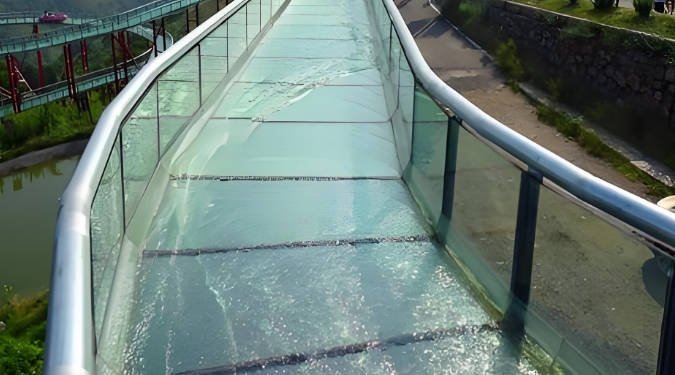
Glass water slides present unique failure modes: delamination of laminated glass, edge chipping from thermal stress, cracking due to impact (e.g., loose jewelry or maintenance tools), and sealant degradation leading to water leakage between panels. A single failure can cause sharp glass fragments to fall into the slide path or water pool, posing severe laceration risks to riders. Systematic glass water slide inspection helps park operators identify early warning signs before catastrophic failure, protect guest safety, extend slide service life, and maintain insurance coverage.
Key Inspection Parameters for Glass Water Slides
1. Visual and Optical Inspection of Glass Panels
Under bright lighting (500–1000 lux), qualified inspectors examine each glass panel for chips, cracks, bubbles, scratches, or nickel sulfide inclusions. We use a polarizing filter to detect residual stress in tempered glass. Any crack longer than 5 mm or any chip reaching the inner ply of laminated glass requires immediate panel replacement. For curved panels, we also check for optical distortion that could disorient riders.
2. Laminated Glass Delamination Testing – Ultrasonic Scanning
Using a handheld ultrasonic bond tester, we scan the interlayer (PVB or ionoplast) between glass plies. Delamination appears as a loss of signal amplitude. Areas of delamination larger than 20 cm² or any edge‑related delamination are flagged for panel replacement. This test is critical for slides exposed to UV radiation, as PVB can degrade over time.
3. Glass Panel Thickness and Edge Quality Measurement
We measure the overall thickness (typically 12–25 mm for laminated glass) and individual ply thickness using a digital caliper or ultrasonic thickness gauge. Edges are examined under 10× magnification for chips, cracks, or grinding defects. Rough or chipped edges reduce bending strength and can initiate catastrophic failure. Acceptable edge finish: arrised (slightly beveled) with no sharp points.
4. Surface Hardness and Scratch Resistance (Glass Surface)
Using a portable hardness tester (e.g., Buchholz or Mohs scratch test), we assess glass surface resistance to mechanical damage. While glass is inherently hard, deep scratches (≥ 0.5 mm deep) become stress raisers and should be polished out or the panel replaced.
5. Load‑Bearing Capacity – Static Load Test – ASTM F2291
We apply a distributed load of 4 kPa (or 1.5× the maximum expected live load from water and riders) to the glass panels using water bags or calibrated weight bags. The panels must sustain the load for 10 minutes without visible deflection exceeding L/100 or permanent deformation, cracking, or sealant failure.
6. Dynamic Impact Test – Simulating Rider Collision
A 50 kg impactor (simulating a rider) is swung into the glass panel at a speed of 4 m/s (approximately equivalent to a 0.8 m drop). The panel must not break or shatter; any crack longer than 50 mm fails the test. For tempered glass panels, a single crack leads to immediate rejection regardless of size.
7. Water Leakage and Sealant Integrity Test
During normal water flow (maximum design flow rate, e.g., 100 L/s), we inspect all joints and gaskets between glass panels for water seepage. Any visible water penetration beyond the first seal indicates gasket compression set or sealant failure. We also measure sealant hardness (Shore A) and check for adhesion failure by pull‑test (ASTM D4541).
8. Anchoring System Inspection (Brackets, Bolts, and Frame)
All metal brackets and support frames are visually inspected for corrosion (salt spray test for coastal installations). We measure bolt torque on a representative sample (e.g., 20% of all connections). Loose bolts are retorqued to the specified value (e.g., 30 N·m for M8 bolts). Any corroded or cracked bracket must be replaced.
9. Thermal Stress Monitoring and Prevention
Glass water slides installed outdoors are subject to differential heating (sunny side vs. shaded side). We install surface thermocouples at 1 m intervals and record temperature differentials during peak sun hours. A ΔT > 20°C across adjacent panels indicates risk of thermal shock cracking. We recommend shading or solar control film in such cases.
10. Operational Testing – Water Flow and Ride Dynamics
With water flowing at normal operating rate, we send trained safety personnel down the slide to verify that the glass panels remain stable, that there is no excessive vibration or fluttering, and that the ride path remains smooth. Any unusual noise (creaking, grinding) indicates loose fixings.
11. UV Degradation of Interlayer and Sealants – Accelerated Weathering
For slides exposed to direct sunlight, we take small‑scale witness samples (glass coupons and sealant specimens) and test them in a xenon arc weathering chamber for 1000–2000 hours. After exposure, we re‑test interlayer adhesion (peel strength) and sealant hardness. Loss of > 30% adhesion or sealant softening are grounds for increased maintenance frequency.
Inspection Frequency and Risk‑Based Classification
Based on our glass water slide inspection findings, we classify slides into three risk categories:
- Low risk (Grade A) – All panels intact, no delamination, sealants flexible, anchor torques within specification. Recommended inspection interval: 12 months.
- Medium risk (Grade B) – Minor edge chips (< 2 mm) that have been polished, minor sealant cracking (non‑leaking). Re‑inspect in 6 months.
- High risk (Grade C) – Cracks, delamination, failed sealants, or loose anchors. Immediate closure until corrective action is taken and re‑inspection passes.
Reporting and Deliverables
Our glass water slide inspection report includes panel‑by‑panel defect mapping (photos, location on plan, defect type and size), ultrasonic bond scan results for each laminated section, sealant pull‑test values, anchor torque log, water leakage observations, load test deformation curves, and a clear pass/fail conclusion with recommended corrective actions (e.g., “replace panel No. 12”, “re‑seal joint between panels 7 and 8”, “retorque anchor bolts on support tower”). Raw data (ultrasonic scans, torque logs, thermal images) are archived for 10 years. We do not issue generic compliance statements without client‑specific acceptance criteria.
In summary, rigorous glass water slide inspection protects riders, lifeguards, and maintenance staff from serious injury while preserving the visual appeal and operational longevity of these signature aquatic attractions. Contact our Baku laboratory to schedule a seasonal inspection before your water park opens for summer operations.
Applications in the Azerbaijani Market
- Water parks (Baku, Sumgayit, Ganja): Annual mandatory inspections for regulatory compliance and insurance renewal.
- New resort complexes (Caspian Sea coastal areas): Pre‑opening load testing and quality verification of newly installed glass slides.
- Hotel indoor pools and wellness centers: Glass slides integrated into architectural elements – specialized non‑destructive inspection.
- Amusement parks and family entertainment centers (FECs): Safety audits for glass slides operating year‑round.
- Maintenance and repair contractors: Post‑repair verification of panel replacements or sealant re‑application.
Why Choose ZKGX?
- State-of-the-art analytical equipment
- Highly qualified scientific team
- Fast turnaround time
- Competitive pricing