
Non‑Destructive Testing – Ensuring Integrity and Safety of Critical Assets in Azerbaijan
In Azerbaijan’s oil, gas, petrochemical, and construction industries, non‑destructive testing (NDT) is essential for verifying the integrity of equipment, pipelines, pressure vessels, and structural components without causing damage. Our ISO/IEC 17025 accredited laboratory provides a full range of NDT services – including ultrasonic testing, radiographic testing, magnetic particle inspection, dye penetrant testing, and eddy current testing – to detect hidden flaws, corrosion, and weld defects before they lead to catastrophic failures.
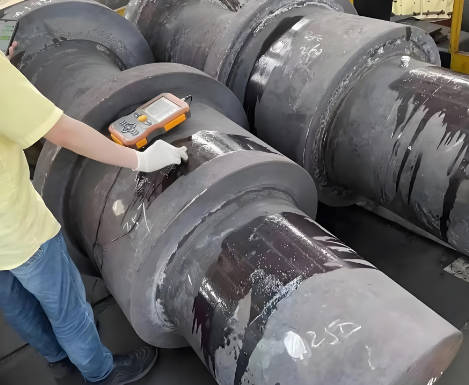
Why Non‑Destructive Testing is Critical for Asset Reliability and Safety
Regular non‑destructive testing helps operators of offshore platforms (BP, SOCAR), refineries (Sumgayit, Baku), gas pipelines (Trans‑Anatolian Natural Gas Pipeline – TANAP), and power plants (Mingachevir) to comply with safety regulations, extend asset life, and prevent unplanned downtime. Our NDT methods are applied during fabrication, installation, and in‑service inspection phases, following international standards (ISO, ASME, API, ASTM).
Core Non‑Destructive Testing Methods We Provide
1. Ultrasonic Testing (UT) – Thickness Measurement and Flaw Detection
We use high‑frequency sound waves to detect internal discontinuities (cracks, inclusions, lack of fusion) in metals, composites, and plastics. Thickness measurement identifies corrosion thinning in pipes and storage tanks. Phased array UT (PAUT) offers advanced imaging for weld inspection.
2. Radiographic Testing (RT) – X‑Ray and Gamma‑Ray
For weld seams and castings, we produce radiographs that reveal internal porosity, slag inclusions, and cracks. Digital radiography provides instant results with high sensitivity. We follow ASME, API 1104, and EN standards.
3. Magnetic Particle Inspection (MPI) – Surface and Near‑Surface Cracks in Ferromagnetic Materials
MPI detects surface and slightly subsurface discontinuities in carbon steel components (e.g., crane hooks, shafts, welds). Using visible or fluorescent particles under UV light, we identify defects that could lead to brittle fracture.
4. Dye Penetrant Testing (PT) – Surface Open Defects in Non‑Magnetic Materials
For aluminum, stainless steel, and plastics, we apply a liquid penetrant that seeps into surface cracks. After developer application, the indications become visible. PT is widely used for machined parts and welded assemblies.
5. Eddy Current Testing (ECT) – Conductive Materials and Heat Exchanger Tubes
ECT detects surface and sub‑surface flaws in conductive materials (copper, aluminum, austenitic stainless steel). We inspect heat exchanger tubes (e.g., in refineries) for pitting, erosion, and cracking without removing tubes.
Advanced Non‑Destructive Testing Techniques
6. Phased Array Ultrasonic Testing (PAUT) – Enhanced Imaging of Welds
PAUT uses multiple elements to steer and focus the sound beam electronically, producing detailed cross‑sectional images of weld profiles. It is faster than conventional UT and provides permanent digital records.
7. Time of Flight Diffraction (TOFD) – Accurate Crack Sizing
TOFD measures the time difference between diffracted signals from crack tips, allowing precise determination of crack height. This method is ideal for critical pressure vessel welds.
8. Guided Wave Ultrasonic Testing (GWUT) – Long‑Range Corrosion Screening
For pipelines and rod bundles, guided wave technology screens long lengths (up to 100 meters from a single access point) to identify areas of general or localized corrosion, prioritizing sections for detailed inspection.
9. Visual Testing (VT) – Direct Surface Examination
Qualified inspectors use borescopes, endoscopes, and high‑resolution cameras to examine internal surfaces of pipes, vessels, and boilers for visible defects (pitting, cracking, deformation).
Industry Applications in Azerbaijan
Our non‑destructive testing services support critical infrastructure across the country:
- Oil and gas pipelines (Baku‑Tbilisi‑Ceyhan, South Caucasus Pipeline, TANAP): In‑line inspection and weld verification.
- Refinery units (SOCAR, Baku refinery): Thickness monitoring for coke drums, catalytic cracking units, and storage tanks.
- Power generation (thermal and hydroelectric plants): Boiler tube inspection, turbine blade crack detection, and generator weld evaluation.
- Construction and structural steel: Bolt hole inspection, bridge truss weld UT, and crane lifting equipment MPI.
- Aerospace and defense: Eddy current inspection of aircraft landing gear and composite components.
Reporting and Compliance
Our NDT reports include defect location (dimensions and coordinates), severity classification, and comparison with acceptance criteria (e.g., ASME B31.3, API 570). We provide traceable calibration certificates, technician qualifications (ASNT Level II/III, PCN, ISO 9712), and raw data archives for 10 years. All inspections are performed under ISO/IEC 17025 accreditation.
In conclusion, non‑destructive testing is an indispensable tool for maintaining safety, reliability, and regulatory compliance in Azerbaijan’s energy, manufacturing, and construction sectors. Contact our Baku laboratory to schedule your next inspection.
Why Choose ZKGX?
- State-of-the-art analytical equipment
- Highly qualified scientific team
- Fast turnaround time
- Competitive pricing